
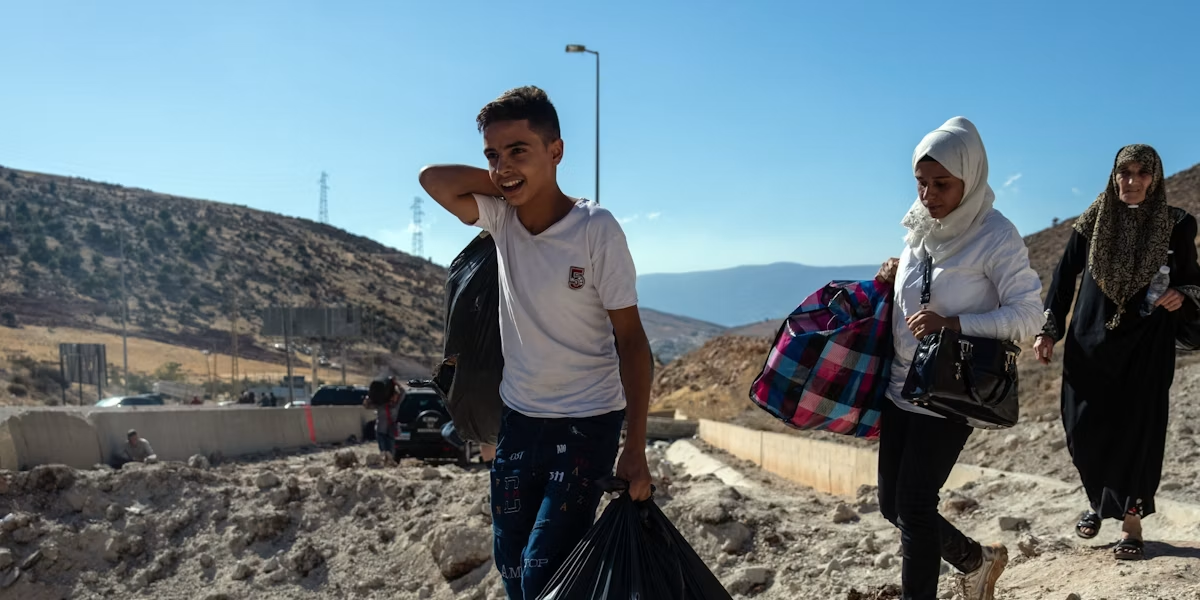
Border entry rules are one of those parts of international travel that look deceptively inconsistent until you start noticing the systems behind them. I have crossed borders where a quick facial scan was enough and others where every page of my travel history seemed to matter. Why Border Entry Rules Differ Between Countries is a question that becomes clearer once you see how law, security, geography, and politics all shape the way each nation controls its entry points.
What stands out most in my experience is that there is no single global standard for immigration. Instead, each country builds its own framework based on risk tolerance, diplomatic relationships, and internal priorities. I have learned that what feels like inconsistency to travelers is actually the result of very different policy objectives operating in parallel.
National Security Priorities And Risk Assessment
One of the biggest reasons border rules differ is how each country defines and manages security risk. Some governments prioritize strict screening at every entry point, while others focus on pre-arrival vetting systems. Why Border Entry Rules Differ Between Countries is closely tied to how much risk a nation is willing to absorb versus how much it wants to filter out in advance. I have seen this difference clearly between countries with highly centralized security systems and those with more flexible entry policies.
What defines this variation is not just technology but political history and threat perception. Countries that have experienced security incidents often adopt more detailed screening processes. I have observed that these systems tend to involve deeper background checks, longer questioning, and stricter documentation requirements.
Other countries take a more open approach, relying on post-arrival monitoring rather than strict entry barriers. I have seen travelers move through such borders quickly, with minimal questioning or documentation checks. That contrast reflects different philosophies of risk management rather than differences in administrative efficiency.
Economic Needs And Travel Policy Design
Economic priorities play a major role in shaping border entry rules. Countries that rely heavily on tourism or foreign investment often design more flexible entry systems to attract visitors. Why Border Entry Rules Differ Between Countries is often influenced by how much a nation depends on international movement for economic growth. I have seen visa-free access offered widely in tourism-driven regions where visitor flow is a key part of the economy.
What defines this approach is the balance between openness and control. Governments may simplify visa requirements, introduce electronic travel authorizations, or expand visa-on-arrival programs. I have observed that these policies are often adjusted to increase competitiveness in global tourism markets.
In contrast, countries with less reliance on inbound tourism or stronger concerns about labor migration may maintain stricter entry conditions. I have seen more extensive visa documentation requirements in such places, including financial proof, employment verification, and travel history checks. That economic balancing act directly shapes how accessible a country feels to travelers.
Diplomatic Relationships And International Agreements
Diplomatic relationships are another major factor that influences border entry rules. Countries often negotiate reciprocal travel arrangements that determine visa requirements and entry conditions. Why Border Entry Rules Differ Between Countries is partly explained by the strength or weakness of these bilateral and regional agreements. I have seen entire regions where travel is relatively seamless due to shared agreements, while others require extensive pre-approval.
What defines this system is reciprocity. If one country allows visa-free access, its partner may extend similar privileges in return. I have observed how political alignment can significantly simplify or complicate travel depending on international relationships.
Regional blocs also play a major role in harmonizing entry rules. Agreements like free movement zones or regional unions reduce internal border controls while maintaining external security standards. I have seen how travelers move freely within such regions while facing stricter checks when entering from outside. That layered structure reflects diplomatic cooperation at multiple levels.
Immigration Control And Population Management
Some countries design border rules specifically to manage long-term population movement. This includes controlling labor migration, student inflows, and permanent residency pathways. Why Border Entry Rules Differ Between Countries is often linked to how governments regulate demographic and workforce changes. I have seen strict entry systems in countries with carefully managed immigration quotas.
What defines this approach is long-term planning rather than short-term travel facilitation. Entry rules are structured to filter not just visitors but potential long-term residents. I have observed that this leads to more detailed visa categories and stricter eligibility requirements.
Other countries adopt more open immigration systems to attract talent and address labor shortages. I have seen simplified work visa pathways and more flexible entry conditions in such destinations. That difference reflects how immigration policy is tied directly to national development goals.
Geography And Border Practicality
Geography also plays a surprisingly important role in shaping border rules. Countries with long land borders, island geography, or remote entry points face very different enforcement challenges. Why Border Entry Rules Differ Between Countries is partly a result of how physically easy or difficult it is to control entry points. I have seen how island nations often rely heavily on airport-based immigration systems because that is their primary point of entry.
What defines geographical influence is infrastructure and accessibility. Countries with limited entry points can enforce stricter controls more easily. I have observed that smaller nations often have highly centralized immigration systems because monitoring entry is simpler.
In contrast, countries with extensive land borders may rely on a mix of formal checkpoints and regional agreements. I have seen variations in enforcement intensity depending on crossing point type. That geographical diversity naturally leads to different rule structures.
Technology Adoption And System Capacity
Technological capability is another key factor behind differing border rules. Countries with advanced digital infrastructure often implement biometric systems, automated gates, and pre-arrival screening tools. Why Border Entry Rules Differ Between Countries is increasingly shaped by how quickly governments can adopt and scale these technologies. I have seen highly automated borders where manual inspection is minimal.
What defines this trend is system capacity rather than intent alone. Even countries that want faster processing may be limited by infrastructure or funding constraints. I have observed that older systems rely more heavily on manual checks, which naturally creates stricter procedural steps.
More advanced systems can afford to be both strict and fast. I have seen how biometric verification and real-time databases allow for quicker decisions without reducing security levels. That technological gap is one of the clearest reasons for differences in traveler experience worldwide.
Final Thoughts
Why Border Entry Rules Differ Between Countries ultimately comes down to a combination of security strategy, economic priorities, diplomatic relationships, geography, and technological capacity. I have learned through extensive travel that these differences are not random but reflect deeply rooted national decisions about risk and mobility.
After observing border systems across multiple continents, I have come to see entry rules as a mirror of each country’s priorities rather than a universal standard. Some prioritize openness, others prioritize control, and many try to balance both depending on circumstance. That balance explains why the experience can change so dramatically from one border to the next.
In the end, border entry rules are less about the traveler and more about how each nation defines safety, opportunity, and access. Once that perspective becomes clear, the variation between countries feels less confusing and more like a map of global priorities in motion.


